
Energy Flow Optimizer
Reduces energy costs and CO₂ through
intelligent and optimized system control.
The software.
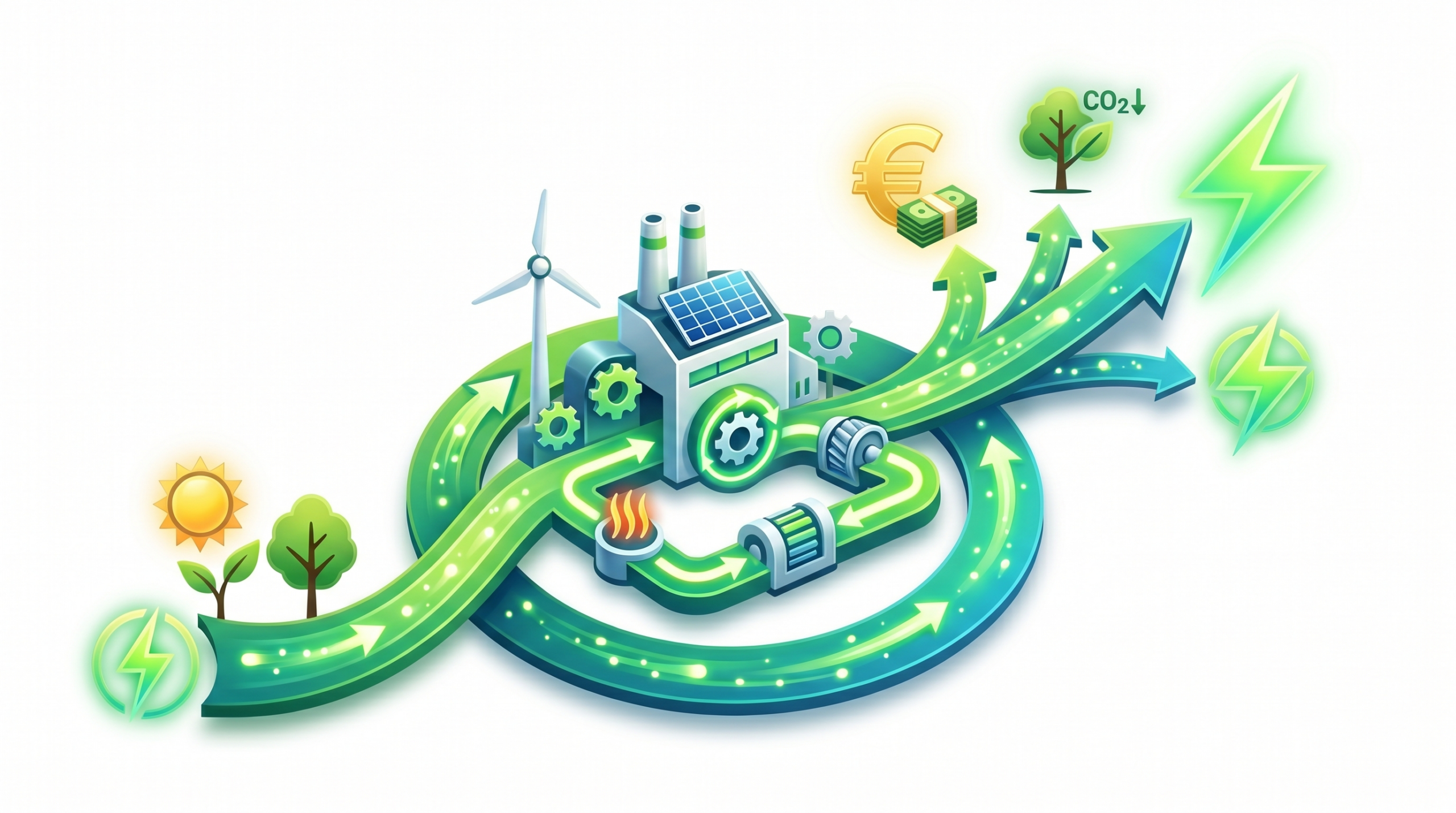
The software analyzes electricity, heat, and storage systems and automatically generates optimal schedules based on price, yield, and demand forecasts — for maximum cost savings, efficiency, and CO₂ reduction.
Significant cost savings & fast ROI
Typically saves up to 20–30% of energy costs in medium-sized systems. The investment usually pays for itself within a short period of time.
Automation instead of guesswork
Automatically receive mathematically optimized daily schedules instead of error-prone manual decisions. Your systems run exactly when it pays off — automatically or with manual control.
Reduce CO₂ & operate sustainably
Optimize not only costs, but also emissions and system wear.
This allows you to combine economic success with real sustainability.
The software in action.
- EFO is individually preconfigured for your system – tailored to your energy generators, storage systems, and optimization goals.
- Implementation is fast and straightforward: in most cases, the software is fully operational within 1–2 days — and we cover the implementation costs.
- Thanks to its flexible architecture, EFO seamlessly adapts to a wide range of systems — from individual production facilities to complex industrial and energy plants..
Funding
Check available funding programs for energy-saving measures
in your federal state — it is often worthwhile.
Trusted By


The testers from our partner Reedholm are used worldwide by leading technology and industrial companies.
How would EFO have performed?
100% convinced – or you pay nothing
We enable a risk-free evaluation of EFO in your system.
We create a representative proof of concept: through a simulation based on your real historical data from the past months, we calculate how your system would have performed with EFO — in direct comparison to your actual performance.
Let's Talk.
We look forward to hearing from you! 🙂
Whether you have initial questions or are interested in a demo – our experts will be happy to take the time for your topic.
Schedule a non-binding initial consultation today!


FAQs
There are many questions — but no good reason not to use EFO.
What is the Energy Flow Optimizer (EFO)?
EFO is a software solution for optimizing energy management in industrial systems. It automatically generates optimal schedules for electricity, heat, and storage processes based on forecasts such as energy prices, generation, and consumption.
For which companies is EFO suitable?
EFO is suitable for companies with complex energy systems, such as industrial facilities, production companies, energy parks, breweries, or sites with their own electricity and heat generation as well as storage systems.
Which systems can EFO control or take into account?
EFO takes into account, among other things:
- Combined heat and power plants (cogeneration systems with all energy sources)
- Boilers of all types
- PV systems
- Battery storage systems
- Thermal storage systems
- Other flexible energy consumers and producers
What makes EFO special compared to traditional energy management systems?
EFO combines the capabilities of large energy management solutions with the flexibility and personalized support of a specialized provider. In addition, each solution is individually tailored to the respective system and is, on average, significantly more cost-effective.
How does the optimization work in practice?
The software uses forecasts (e.g. electricity prices, gas prices, PV output, heat demand) and automatically calculates the economically and/or ecologically optimal operation of all connected systems.
For this purpose, complex optimization algorithms and AI models are used, running on scalable computing systems. Depending on the complexity of the installation as well as the frequency and time intervals, different servers and models are applied to calculate the optimal solution up to a defined target value. The optimization progress can be monitored online, and in cases where a solution is not feasible, the exact cause is displayed (e.g. excessively high forecasted heat or electricity demand).
From this, a schedule is created specifying which system component should be switched on or off, and to what extent, at each point in time.
Depending on requirements, data can be provided to the system and results can be retrieved. Currently, data transfer is possible via SFTP (CSV formats) or via REST services (HTTPS with secure access token). Other interfaces can be implemented upon request.
Do I need to completely change my processes?
No. EFO is adapted and integrated into your existing infrastructure. Existing processes can be maintained or selectively optimized.
How complex is the implementation?
Standard systems are typically set up within a few hours — depending on your individual setup and requirements. After that, the system is quickly ready for use and can be tested in production immediately.
How long does it take until EFO is ready for use?
EFO is typically fully configured and ready to use within 1–2 days. The exact duration depends on the complexity of the individual system.
How does the pricing model work?
The pricing model consists of:
- a monthly usage-based SaaS subscription
including hosting, support, and optionally training
What does “usage-based pricing model” mean?
The monthly costs depend on the extent of usage or the complexity of the installed system. This keeps the system fair and scalable.
Are there discounts?
No. Our pricing structure is intentionally transparent, value-based, and consistently designed. Instead of discounts, the focus is on measurable value for the customer. We avoid discounts to ensure the quality, fairness, and comparability of our solution. The price reflects the actual value and the achieved savings.
What savings are realistic?
Typically, medium-sized systems can achieve savings in the range of 10–30%.
In most cases, this leads to a very fast return on investment.
How can I verify whether I am actually operating more efficiently or optimally with EFO?
With the data you provide, a retrospective simulation is also possible. This evaluates how your consumption and efficiency would have behaved with and without EFO, making actual savings and optimizations transparent and traceable.
What causes these high savings?
Through the automatic optimization of:
- Time-dependent energy prices (electricity/gas) are optimally used for purchasing and (where possible) selling energy
- On-site generation (e.g. PV systems, power plants) is operated when demand can be covered in a cost-optimized way or surplus energy can be sold
- Storage systems are used to store energy when it is cheap and discharge or use it during high-price periods
- Load shifting of consumers into periods of lower energy purchase costs or production
- More efficient plant operation, depending on boundary conditions such as minimum runtime, start-up times, or residual energy utilization
Can EFO also reduce CO₂ emissions?
Yes. In addition to cost optimization, EFO can also be optimized for CO₂ emissions or machine wear.
Can I choose between cost and CO₂ optimization?
Yes. The optimization objective is individually configured according to your requirements.
How individual is the solution?
Each installation is configured specifically for the customer – depending on the system structure, energy sources, and optimization goals. In addition, only the functions that are actually required are activated.
If a function for a specific system component does not yet exist, it can usually be integrated into our modular system in a very short time – supported by AI.
How flexible is EFO with different systems?
Very flexible. EFO can be adapted to a wide range of industrial energy systems – from small sites to complex energy parks.
Is there personal support?
Yes. Each customer is assigned a dedicated contact person who supports them from implementation through to ongoing operation.
Is EFO difficult to use?
No. The interface is intuitively designed and clearly displays energy flows, generators, consumers, and storage systems in an easy-to-understand way.
Can I also control systems manually?
Yes. In addition to automatic optimization, manual control is also possible at any time.
Why should I use EFO?
Because EFO not only optimizes energy flows, but also measurably reduces costs, can automate processes when needed, and is flexible enough to adapt precisely to your system – without unnecessary complexity or standard solutions.
Are my data secure with EFO?
All data communication and storage is fully encrypted.
In addition, our servers are hosted with an Austrian partner that is ISO 27001 certified and therefore meets very high security standards, as required by major energy companies.

